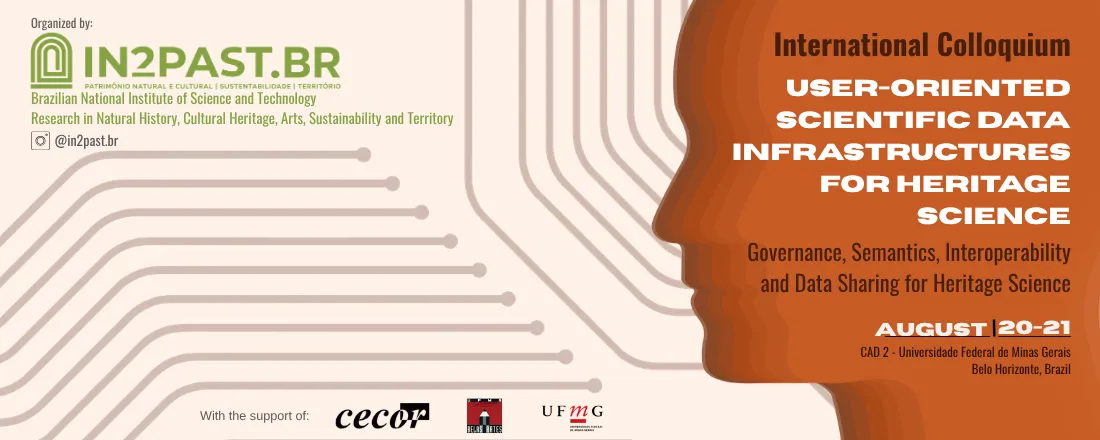
Colloquium User-Oriented Scientific Data Infrastructures for Heritage Science

Colloquium User-Oriented Scientific Data Infrastructures for Heritage Science

online Centro de Atividades Didáticas 2 (CAD 2) - Universidade Federal de Minas Gerais - Belo Horizonte - Minas Gerais - Brasil
presencial With online streaming

Essential Event Information

✓ Free registration required
✓ Hybrid event: in-person and online participation
✓ Event conducted in English
✓ Live online streaming with Portuguese subtitles for registered participants
✓ Digital certificate of participation available*


Event Dates and Hours

Day 1 — Thursday, 20 August 2026
8:30 AM–5:00 PM (Brasília Time — BRT, UTC−3)
Registration and badge collection from 8:30 AM. Scientific programme from 9:00 AM.

Day 2 — Friday, 21 August 2026
9:00 AM–1:00 PM (Brasília Time — BRT, UTC−3)


*The certificate will be issued to registered participants who attend at least two of the three programme periods (Thursday morning, Thursday afternoon and Friday morning) and have their attendance properly recorded.

About the Event

COLLOQUIUM
User-Oriented Scientific Data Infrastructures for Heritage Science

Governance, Semantics, Interoperability and Data Sharing for Heritage Science

This colloquium is organised by INCT IN2PAST.Br (Brazilian National Institute of Science and Technology - Research in Natural History, Cultural Heritage, Arts, Sustainability and Territory) committed to advancing interdisciplinary research, scientific innovation, and international collaboration in Heritage Science. The Institute brings expertise in conservation, analytical sciences, digital technologies, and cultural heritage research to promote the scientific infrastructures needed for the next generation of heritage research.

Heritage Science is undergoing a profound transformation. Advances in analytical techniques, scientific imaging, artificial intelligence, and digital technologies have expanded our ability to investigate, understand, and preserve cultural heritage. As a result, researchers and institutions are generating unprecedented volumes of scientific data, creating new opportunities while presenting major challenges for their long-term management, accessibility, interoperability, and reuse.

These challenges extend well beyond Cultural Heritage. Similar issues are emerging across biodiversity, environmental sciences, forensic sciences, and many other disciplines, where scientific data have become strategic resources for research, innovation, public policy, and international collaboration. Scientific data infrastructures are therefore no longer viewed simply as repositories, but as dynamic ecosystems connecting data, knowledge, people, technologies, and institutions.

This colloquium has been conceived as a forum for dialogue rather than as a showcase of finished solutions. Its primary objective is to identify common challenges, exchange experiences across disciplines, and discuss the conceptual, technical, and organisational foundations required to build user-oriented scientific data infrastructures for Heritage Science. Governance, semantics, interoperability, metadata, artificial intelligence, long-term preservation, and international collaboration lie at the heart of these discussions.


The programme brings together leading specialists from universities, research institutes, museums, public agencies, international organisations, and digital infrastructure initiatives. Their diverse expertise reflects the interdisciplinary nature of these challenges and the growing recognition that no single institution or discipline can address them alone.


By fostering dialogue between Heritage Science and related fields, we hope this meeting will contribute to the development of robust, interoperable, and sustainable scientific data infrastructures capable of supporting research, conservation, heritage valorisation, evidence-based public policy, the prevention and combating of the illicit trafficking of cultural property, and education. More broadly, we hope these discussions will strengthen international cooperation and contribute to safeguarding both cultural and natural heritage, recognising that the knowledge we generate today is itself a strategic resource for future generations and for a more sustainable world.


Registration

{{'Label_CodigoPromocionalAplicadoComSucesso' | translate}}
{{'Label_Presencial' | translate}} {{'Label_Online' | translate}} {{'Label_PresencialEOnline' | translate}}
{{item.ingressoPrecoAtual.titulo}}

{{item.titulo}}

{{'Label_DoacaoAPartir' | translate}} {{item.valores[0].valor | currency:viewModel.evento.moeda}}

{{item.descricao}}
{{'Titulo_Gratis' |translate}} {{viewModel.configuracaoInscricaoEvento.descricaoEntradaGratis}}
{{entrada.valor | currency:viewModel.evento.moeda}} {{entrada.valor | currency:viewModel.evento.moeda}}  

{{entrada.valorComDesconto | currency:viewModel.evento.moeda}}

{{'Titulo_Ate' | translate}} {{entrada.validoAte |date: viewModel.evento.cultura.formatoData}}
{{'Label_APartirDe' | translate}} {{entrada.validoDe | date:viewModel.evento.cultura.formatoData}}
Calendar

{{'Titulo_NaoDisponivel' | translate}}

Program

{{item.titulo}}
{{item.horaInicio}}-{{item.horaFim}}
Calendar

Speakers

Paulo Duarte Neto

Paulo José Duarte Neto is an Associate Professor in the Department of Statistics and Informatics at the Federal Rural University of Pernambuco (UFRPE), where he is a permanent faculty member of the Graduate Programs in Biometry and Applied Statistics and in Biodiversity. He holds doctoral degrees from UFRPE and the University of Antwerp and completed postdoctoral research at Aix-Marseille University. He is a CNPq Research Productivity Fellow and currently serves as Research and Innovation Director of the Brazilian National Network of Forensic Isotopes. He leads the Laboratory for Statistical and Computational Modeling of Complex Natural Phenomena (LACUNA). His research focuses on image analysis and the statistical and computational modeling of complex natural phenomena.

Aline Minervino
Aline Minervino is a Federal Forensic Expert specialising in forensic genetics, strategic management, and international cooperation. She currently coordinates the Steering Committee of Brazil’s Integrated Network of DNA Databases and serves as Administrator of the National DNA Database. She also represents Brazil on INTERPOL’s DNA Monitoring Expert Group. At the National Police Academy, she coordinates academic programmes and CNPq-supported research. A specialist in Disaster Victim Identification and CBRN protocols, she is a PhD candidate in Forensic Sciences at the University of Porto and holds an MSc in Public Health and a degree in Dentistry from the University of Brasília.


Arnaldo Santos
Arnaldo Gomes dos Santos Junior is a Digital Forensics Expert with the Brazilian Federal Police, where he has developed technological solutions for criminal investigations since 2002. He has 35 years of experience in information technology and holds bachelor’s and master’s degrees in Computer Science from the Federal University of Minas Gerais, as well as postgraduate qualifications in Information Security, Data Analysis, and Machine Learning. From 2021 to 2023, he served as an INTERPOL Cybercrime Officer in Singapore.


Marcelo Maffra
Marcelo Azevedo Maffra is a PhD candidate in Cultural Assets and Social Projects at FGV/CPDOC. He holds a master’s degree in Public Law and a law degree from PUC Minas. He has served as a public prosecutor at the Public Prosecution Service of Minas Gerais (MPMG) since 2005 and, since 2020, has coordinated its Cultural Heritage Protection Prosecutors’ Offices. From 2009 to 2016, he served as MPMG’s Regional Environmental Coordinator. He is also a member of the Minas Gerais State Archives Council and the Historical and Geographical Institute of Minas Gerais, and teaches Cultural Heritage Law.


Clara Baringo
Clara Baringo Fonseca is a biologist and biodiversity data specialist at the Brazilian National Research and Education Network, RNP, working with the Brazilian Biodiversity Information System, SiBBr. She is part of the Brazilian node of the Global Biodiversity Information Facility, GBIF, and also contributes to the management of the Brazilian node of the Ocean Biodiversity Information System, OBIS. Her work focuses on the management, standardization, mobilization, and integration of biodiversity data, as well as on data publication workflows and capacity building for scientific communities, helping connect national infrastructures with international biodiversity data networks.


Alexandre Cavalcanti G Neto
Alexandre Cavalcanti works at Brazil’s National Historical and Artistic Heritage Institute (IPHAN), where he heads the National System of Cultural Heritage Information and Indicators (SNIIP) Division. He holds a degree in Archaeology from the Federal University of Pernambuco (UFPE), with an undergraduate thesis focused on cultural heritage protection legislation. At IPHAN’s headquarters, his management experience includes intergovernmental coordination to strengthen heritage policies and acting as a Product Owner in the development of strategic enterprise systems — most notably platforms for automated heritage impact assessment in environmental licensing and heritage data management. In the private sector, he has served as Director, Project Manager, Project Coordinator, and Archaeologist for specialized heritage consultancies.


Elvys Soares 
Elvys Soares is a researcher and professor at the Federal Institute of Alagoas (IFAL). He holds a PhD in Computer Science from the Federal University of Pernambuco (UFPE), as well as a master’s degree in Computational Modelling of Knowledge and a bachelor’s degree in Computer Science, both from the Federal University of Alagoas (UFAL). His research experience lies in Software Engineering, with particular interests in quality assurance for software products, processes and data. He is the lead researcher for the partnership between UFAL and IPHAN, which aims at the technological modernization of the latter.


Flávio Medeiros
Flávio Medeiros is a professor at the Federal Institute of Alagoas (IFAL) and a researcher at NEES, the Center of Excellence in Social Technologies (UFAL). He holds a BSc in Computer Science (UFAL), an MSc in Software Engineering (UFPE), and a PhD in Software Engineering (UFCG). His expertise lies in Software Engineering and data governance, with experience in data quality, standards, and interoperability in large-scale information systems.


Renato Freitas
Renato Freitas is a tenured Professor of Physics in Basic, Technical and Technological Education at the Federal Institute of Rio de Janeiro (IFRJ). He is a member of INCT IN2PAST.Br, the Brazilian National Institute of Science and Technology for Research in Natural History, Cultural Heritage, Arts, Sustainability and Territory, and coordinates IFRJ’s Mobile Laboratory, dedicated to the scientific investigation of historical and cultural heritage. He specialises in non-destructive and in situ analytical techniques, including X-ray fluorescence (XRF), macro X-ray fluorescence (MA-XRF), hyperspectral imaging and infrared reflectography (IR), as well as scientific computing, data analysis and scientific instrumentation. He collaborates with Brazilian institutions working in cultural heritage preservation and forensic science, including the Brazilian Institute of Museums (IBRAM) and the Carlos Éboli Institute of Criminalistics (ICCE/PCERJ). In 2026, he received the Medal of Friendship from the Civil Police of the State of Rio de Janeiro in recognition of his contributions to technical and scientific cooperation.


Eduardo D Mio
Eduardo Mio is a master’s student at the SPEED Laboratory at the Federal University of Minas Gerais (UFMG). His research focuses on data science applied to healthcare, particularly artificial intelligence. His current work investigates the automated prediction of diseases from electrocardiogram (ECG) data.


Franco Niccolucci
Franco Niccolucci is a former professor at the University of Florence, Italy. He is the Scientific Coordinator of ARTEMIS. In 2008 he became the Founding Director of a novel research centre in Nicosia, Cyprus, the “Science and Technology in Archaeology and Cultural Heritage Research Centre”, where he remained until 2013. In the meantime he maintained the role of director of the VAST Research Laboratory at Fondazione PIN in Italy. In this position he led the large-scale EU Projects ARIADNE (2013-2017) and ARIADNEplus (2017-2022) on archaeological and cultural heritage data, eventually founding in 2022 the ARIADNE RI (Research Infrastructure) AISBL, an organization that currently manages a catalogue of over 4.000.000 archaeological and heritage datasets from all of Europe and beyond. Niccolucci is the President and Director of ARIADNE RI, where he leads a team of researchers working on advanced projects on heritage digitization.


Dennis Wuthrich
Dennis Wuthrich is the founder and CEO of Farallon Geographics and a lead developer of the Arches platform. He has been closely involved in the development of Arches since its early stages, working at the intersection of geospatial technologies, semantic data modeling, interoperability, and cultural heritage information management. He is also a member of the Arches Project Governance Committee and continues to contribute to the development and evolution of the Arches ecosystem, including its applications for heritage and scientific data management.


Catherine Patterson
Catherine Patterson is a conservation scientist at the Getty Conservation Institute (GCI), specialising in the technical examination of paintings and illuminated manuscripts. She holds a PhD in Physical Chemistry from Northwestern University. Her work focuses on artists’ materials and practices, material changes over time, analytical methodology development, and technology transfer for cultural heritage preservation. She is also interested in science and heritage diplomacy and policy development for the field. Before joining the GCI staff in 2009, she held its Postdoctoral Fellowship in Conservation Science, and in 2023, she completed an AAAS Science and Technology Policy Fellowship at the US National Science Foundation.

Venue

{{viewModel.evento.titulo}}

{{viewModel.evento.responsavelEvento}}